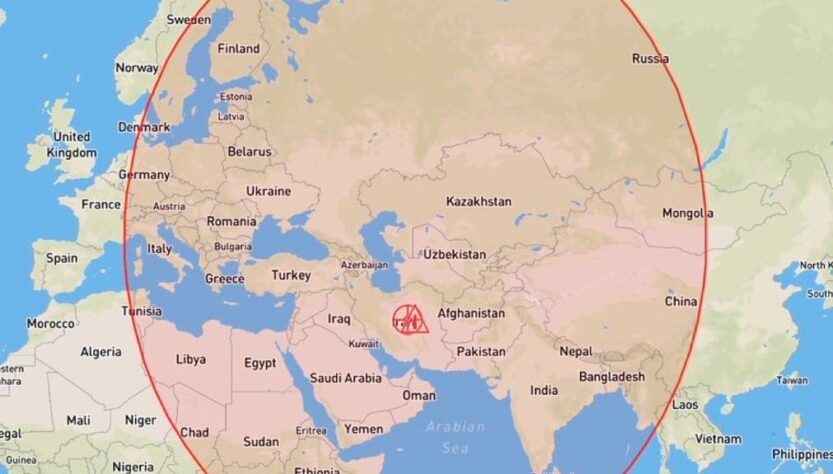
INDIAN OCEAN (21 March 2026) – Iran’s overnight launch of two long-range ballistic missiles toward the U.S.-U.K. base on Diego Garcia failed to score a hit, but succeeded in delivering a stark warning: Tehran now has the demonstrated range to threaten deep into Europe.
Neither missile reached its target. One disintegrated in flight; the other was intercepted by a U.S. Navy SM-3. Yet the attempt itself marks a dramatic escalation. For years Iran publicly capped its ballistic-missile range at 2,000 kilometres. Last night’s salvo—almost certainly using the Khorramshahr-4—effectively doubled that figure to around 4,000 km, the same family of missiles that has spent recent weeks showering Israeli cities with cluster munitions.
A 4,000-kilometre arc from Tehran sweeps across the Mediterranean and places Paris, London, Berlin, Rome, and Brussels within theoretical reach. What European leaders treated as a remote Middle Eastern conflict is no longer distant.
🚨🇮🇷 PICTURED: The implied range of Iran’s missiles
— Politics Global (@PolitlcsGlobal) March 21, 2026
It was believed that Iran’s max firing range was 2000km, but this has been revised after they fired at the Diego Garcia base, which is roughly 4000km away pic.twitter.com/yiyWfRyg2f
The uncomfortable reality is that Europe owes a debt of gratitude to President Donald Trump and the United States.
In late February, U.S. and Israeli forces—acting on high-level American authorisation—struck the regime’s command core. Supreme Leader Ayatollah Ali Khamenei was killed. Senior IRGC missile commanders were eliminated. Critical launch coordination nodes, fuel depots, and command posts were destroyed in what military sources describe as a textbook decapitation strike.
That single campaign severed the snake’s head. Without it, last night’s ragged, uncoordinated launch could have been the opening move of a far more dangerous campaign—better synchronised, more heavily armed, and potentially sustained. Instead, what the world witnessed was the thrashing of a headless body: technically capable on paper, but crippled in practice.
The malfunctioning missile and the straightforward interception are not signs of Iranian strength. They are symptoms of a regime whose decision-making chain has been broken. Europe’s capitals spent years reassuring themselves that geography provided safety. That illusion ended over the Indian Ocean.
The United States did not wait for European consensus or for the threat to mature. Under Trump’s direction, America removed the architect of escalation and gutted the infrastructure needed to turn long-range theory into battlefield reality.
The war continues. The Iranian regime remains dangerous. But the decisive blow that robbed it of its brain has already saved lives—and quite possibly spared European soil from the very weapons that failed so publicly last night.
Europe may not like the messenger, but it should recognise the service: thank you, President Trump; thank you, United States. You cut off the head before the fangs reached Paris or London. The body still twitches, but the worst has been averted.
🚨JUST IN: In a bombshell move, Iran launched two intermediate-range ballistic missiles toward the "Diego Garcia", missing the target but demonstrating a doubled range of 4,000 km compared with prior 2,000 km capabilities, meaning "Iranian missiles can now reach even Europe." pic.twitter.com/uQN0cMPStb
— WORLD NEWS (@_MAGA_NEWS_) March 21, 2026
